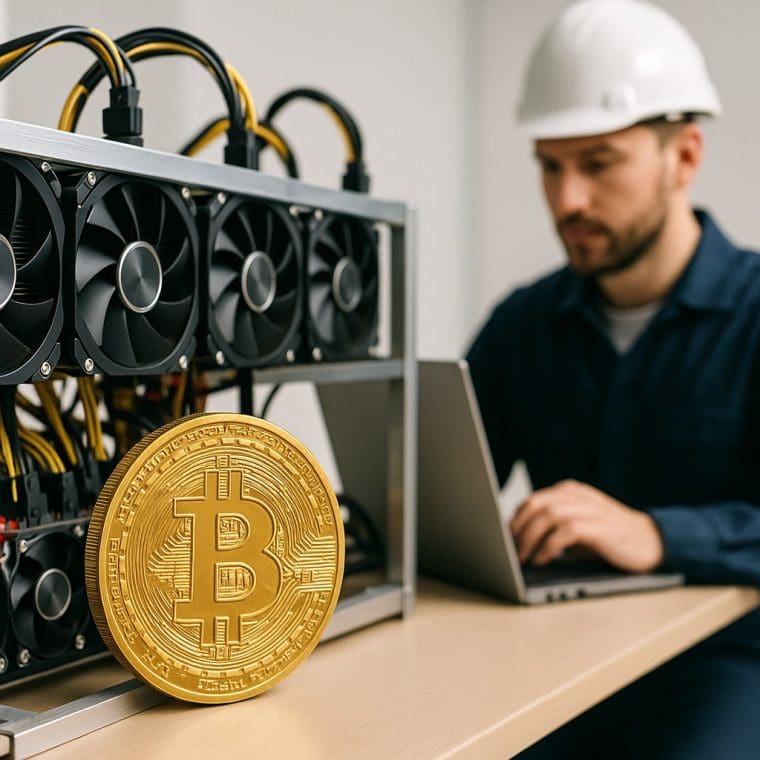
Explain how Bitcoin mining works, current hashrate trends post-halving, and the role of renewable energy in network security, using updated data to educate beginners without diving into specific geographic operations.
Transcript
Mike: Bitcoin mining uses more electricity than some small countries. And that’s exactly what makes Bitcoin the most secure financial network in history. Today we’re going to explain why that’s not a contradiction.
Mike: Have you ever wondered why miners spend millions on electricity just to “find” digital coins – and why that energy burn actually protects your savings?
Mike: By the end of this episode, you’ll understand how mining turns raw electricity into unbreakable security, why the 2024 halving didn’t weaken the network, and how renewable energy is quietly making Bitcoin stronger. I’m Mike.
Lauren: And I’m Lauren. Welcome to BitTalk.
Mike: Before we dive in, we’ve got a quick word from a sponsor that’s doing real work in the Bitcoin space.
Sponsor (intro):
Bitcoin Veterans isn’t just another online group. It’s a community built specifically for those who served, creating a space where service, purpose, and Bitcoin converge. We work with veterans through education, events, podcasts, and local meetups to help them connect, learn, and find a new mission in the Bitcoin space. If you or someone you know served, head to BitcoinVeterans.org.
Mike: So let’s start with the image most people have. When they hear “Bitcoin mining,” they think of guys with pickaxes in a dark tunnel.
Lauren: Blame the early cypherpunks. It’s a terrible name, honestly.
Mike: Right. So what’s actually happening? What’s the reality?
Lauren: The reality is that mining is a global competition. Imagine billions of computers around the world all guessing a number. The one that guesses correctly gets to add the next page to Bitcoin’s permanent ledger. But the number is so hard that the only way to win is to burn enormous computing power – which means burning electricity.
Mike: So it’s like a combination lock. You have to turn the dial, guess the code, and the only way to hit it is sheer brute force. No shortcuts.
Lauren: Exactly. The puzzle is based on SHA-256 cryptography. There’s no clever trick. You just have to try billions of guesses per second until you find the one that works. That guesser, that miner, then gets to add the next block of transactions to the chain and collects the reward.
Mike: And that reward is how new bitcoin enters circulation. Currently, it’s 3.125 BTC per block. Plus all the transaction fees in that block.
Lauren: And that reward gets cut in half every 210,000 blocks. That’s the halving. It enforces a hard cap of 21 million bitcoin. No central bank, no political decision – just math.
Mike: So the energy isn’t waste. It’s the security budget. The price the network pays to make rewriting history economically impossible.
Lauren: It’s the most expensive firewall in history, and it pays for itself.
Mike: Okay, so we’ve established the basic mechanism. But what’s happening right now? The 2024 halving happened over two years ago. Did it break mining? Did it make the network weaker?
Lauren: The data says exactly the opposite. As of mid-2026, the network hashrate is estimated between 850 and 930 exahashes per second. That’s approaching 1 zettahash per second.
Mike: That’s a billion trillion hashes per second. Every second.
Lauren: Right. And mining difficulty is at an all-time high, around 134 to 139 trillion. That means the network has already adjusted the puzzle to compensate for all that added computing power.
Mike: So if the reward is cut in half, why are miners piling in?
Lauren: Because the network is more valuable than ever. Cheap energy, better hardware, and the security premium. The market is signaling that securing Bitcoin is worth the investment. Inefficient miners drop out, efficient ones scale up. The network doesn’t care – it just gets more secure.
Mike: Okay, we’ve seen the hashrate numbers and the halving mechanics. But what does this actually mean for someone who holds bitcoin or is just learning about sound money? How does any of this affect you?
Lauren: That’s the pivotal question. And it leads us straight into the energy discussion.
Mike: Let’s talk about the criticism. People say Bitcoin mining uses too much electricity, that it’s destroying the planet.
Lauren: And they miss the entire point. The high energy use is a feature, not a bug. Without it, the network would be trivial to attack. The electricity cost is what makes it economically impossible to rewrite history.
Mike: So it’s the cost that creates the trust. You can’t cheat because you’d have to burn an insane amount of energy to do it. But where does that energy come from?
Lauren: Here’s where it gets interesting. Miners are extremely price-sensitive. They want the cheapest electricity they can find. And what’s often the cheapest?
Mike: Renewables. Stranded energy. Surplus hydro, flared natural gas, curtailed wind.
Lauren: Exactly. I recently saw photos of mining containers parked next to hydro dams in remote areas. They’re literally using power that would otherwise be wasted.
Mike: And critics still call it wasteful.
Lauren: Right. Because they don’t understand that mining can act as a flexible grid load. When there’s excess renewable energy, miners can turn on and absorb it. When demand spikes, they can shut off instantly. They stabilize the grid.
Mike: So mining is actually a buyer of last resort for renewable energy. It makes renewables more viable economically.
Lauren: Precisely. And that brings us back to the basic question: how does the network keep finding exactly one block every 10 minutes, even when the number of miners changes wildly?
Mike: That’s the thread we planted at the top. Let’s tie it together.
Lauren: It’s the automatic difficulty adjustment. Every 2,016 blocks, roughly two weeks, the network recalculates how hard the puzzle needs to be to keep block times at 10 minutes. If more miners join and hashrate goes up, the puzzle gets harder. If miners leave, it gets easier.
Mike: So more hashrate doesn’t mean faster blocks. It just means security goes up.
Lauren: Right. No matter what, you get a block every 10 minutes. And the security of that block is directly proportional to the energy spent to find it.
Mike: That’s elegant. The protocol enforces both pace and cost. Human action can’t speed it up or slow it down.
Sponsor (mid-roll):
If you’re a regular listener, you know the guys grinding hardest in Bitcoin aren’t always the ones with the biggest portfolios. Bitcoin Veterans is a community of military veterans and Bitcoin advocates focused on something that matters more than price action: mission, education, and resilience. They run meetups, podcasts, and events that help veterans rebuild purpose and keep growing through Bitcoin. The resources are solid and the community is real. If you’re a veteran, or you want to support one finding their next mission, check out BitcoinVeterans.org.
Mike: And we’re back. So we’ve got this incredibly secure, energy-backed network. But what does that mean for you as an individual?
Lauren: Here’s the connection: mining secures the ledger against double-spends and censorship. But it does not hold your coins. It does not sign for you.
Mike: So you can have the most secure network in the world, but if someone else has your private keys, you don’t own your bitcoin.
Lauren: Exactly. The energy-backed security means you don’t have to trust a bank. But you do have to trust yourself with your keys.
Mike: That’s the tradeoff. The network provides the foundation; self-custody provides the ownership.
Lauren: And that’s the complete stack. Mining ensures the ledger can’t be rewritten. Consensus rules enforce the supply cap. And self-custody ensures you are the sovereign over your own savings.
Mike: So sound money isn’t just about scarcity. It’s about scarcity enforced by physical energy and transparent rules, not political promises.
Lauren: In fiat systems, the security of your savings depends on political decisions and central bank policy. In Bitcoin, it depends on math, code, and the physical reality of global energy expenditure.
Mike: That’s a powerful distinction. Now, let’s talk about where we’re headed. The approach to 1 zettahash is a landmark.
Lauren: It is. That’s a billion trillion hashes per second. It represents a scale of decentralized, energy-backed security that no other system has ever achieved.
Mike: And as block rewards continue to shrink, miners will increasingly rely on transaction fees. Is that a risk?
Lauren: It’s a transition. But the protocol is designed for it. As the network becomes more valuable and more people transact, fees will naturally increase. The security model doesn’t break; it just evolves.
Mike: One last question. Is there any risk that mining becomes too centralized if only big players can afford it?
Lauren: It’s a valid concern. But economics and geography have a way of dispersing things. The cheapest energy isn’t all in one place. It’s everywhere – hydro in mountainous regions, solar in deserts, flared gas in oil fields. Mining follows cheap energy, and cheap energy is distributed.
Mike: So the network remains secure regardless of who wins the block.
Lauren: Right. The difficulty adjustment ensures that, and the distributed nature of cheap energy ensures it too.
Mike: So next time someone says Bitcoin mining is a waste of energy, you can explain it’s actually the most expensive firewall in history.
Lauren: And it pays for itself in security.
Mike: Let’s wrap it up. We started with a contradiction: high energy use and high security. We’ve shown that the energy isn’t waste – it’s the security budget. The 2024 halving didn’t weaken the network; it made it more resilient. Renewable energy is quietly making Bitcoin stronger. And if you hold your own keys, you’re plugging into that entire system.
Mike: If this helped you understand Bitcoin better, follow the show, leave a like, subscribe – it helps more people find this content and helps spread Bitcoin. Next time, we’re going to answer the question that started it all: how does a decentralized network with no leader make any decisions at all? Don’t miss that.
Mike: Thanks for spending time with us on BitTalk. If this was useful, follow the show, leave a like, and subscribe. It helps more people find us and helps spread Bitcoin. Until next time, keep learning, keep questioning, and keep stacking knowledge.
Discussion
Join the Conversation