
Most people are introduced to Bitcoin through headlines about price swings, billionaires, or market drama. That is understandable, but it also misses the bigger story. Bitcoin is not only a speculative asset or a piece of technology. For many people, it represents a challenge to how modern money works and who gets to control it.
That is why the debate around Bitcoin gets so intense. The real question is not just whether Bitcoin will go up or down. The deeper question is whether money itself has become unstable, distorted, or overly dependent on central authorities. Once you start looking at Bitcoin through that lens, the conversation becomes much bigger than finance.
What does it mean to “fix money”?
When people ask whether Bitcoin can fix money, they first need to ask what money is supposed to do. At its core, money is a tool. It should help people store value over time, exchange goods and services efficiently, and measure economic value in a way that is broadly trusted. A well-functioning monetary system should be stable enough for long-term planning and flexible enough to support economic activity.
The problem is that money can stop doing those jobs well, especially when it becomes easier to create more of it without meaningful limits. When that happens, people may still use it every day, but they begin to feel the effects in other ways. Their savings buy less over time, prices become harder to interpret, and the system starts rewarding debt, speculation, or asset inflation more than patience and productivity. That is the background frustration Bitcoin taps into.
The idea of sound money
One of the core ideas behind Bitcoin is something called sound money. In simple terms, sound money is money that cannot be easily manipulated or diluted. It is expected to hold its value better over long periods because its supply is constrained and predictable. Historically, gold is often used as the classic example because it is difficult to produce and cannot be created with a keystroke.
Scarcity matters because it shapes trust. When people know that something cannot be endlessly expanded, they are more likely to believe it will preserve value over time. That does not mean sound money is perfectly stable in the short term, but it does mean people can have more confidence in its long-term integrity. Bitcoin supporters argue that in a world where currencies can be expanded rapidly, scarcity is not just a feature. It is the foundation.

Why central banking is part of the argument
To understand why Bitcoin exists, you also need to understand why many people are skeptical of central banking. Central banks play a major role in modern economies. They influence interest rates, manage the money supply, and step in during financial crises. Supporters see this as necessary because it helps stabilize the economy, smooth shocks, and prevent panic.
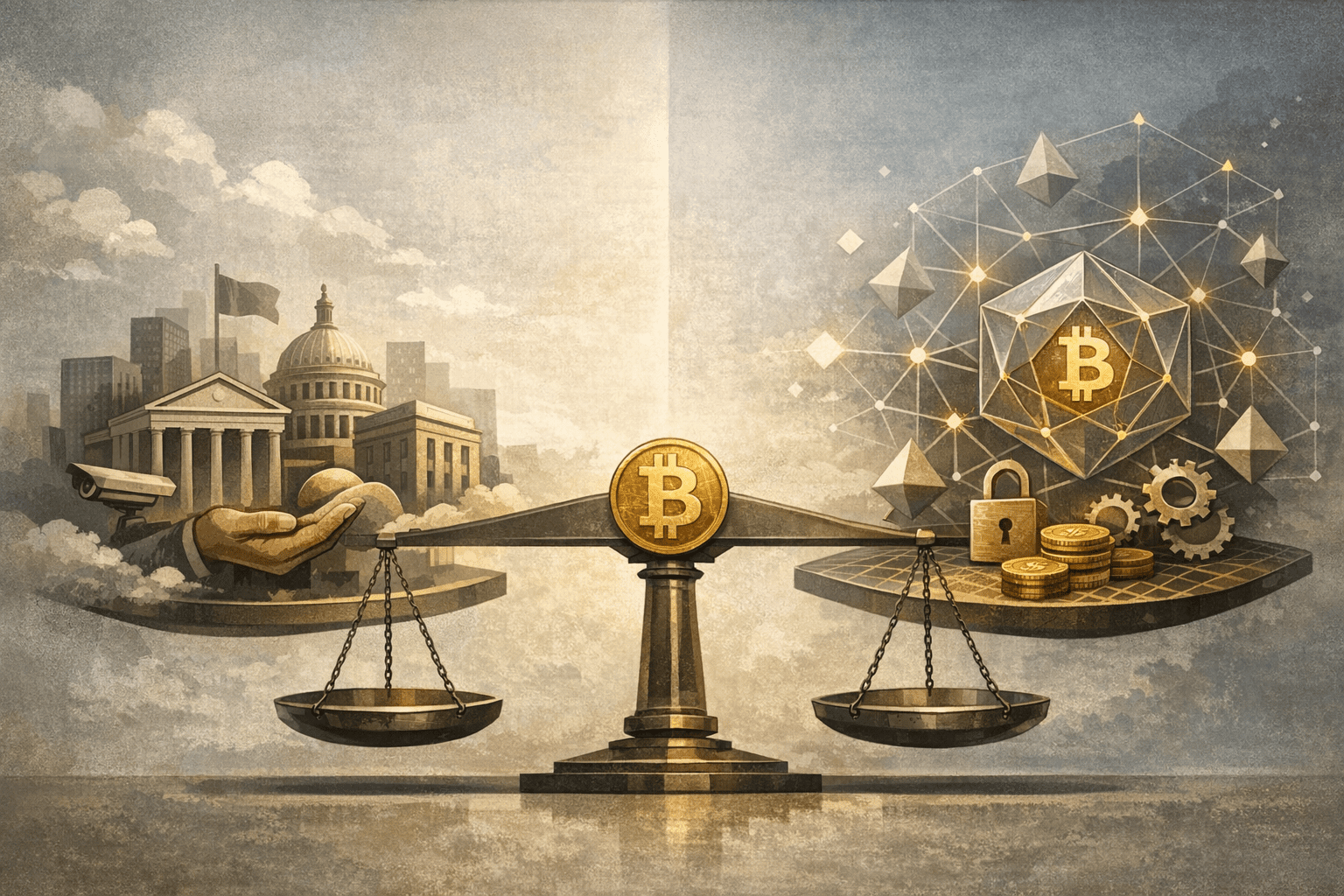
Critics see a different picture. They argue that the ability to create money at scale gives too much power to central institutions and often benefits those closest to the financial system first. In their view, this can inflate asset prices, erode purchasing power, reward excessive leverage, and make ordinary people absorb the long-term costs through higher prices and weaker savings. Bitcoin appeals to people who believe money should not depend so heavily on trust in policymakers.
Bitcoin’s answer: fixed supply and rules without rulers
Bitcoin’s answer to these concerns is radical in its simplicity. The system has a capped supply of 21 million coins, and the issuance schedule is known in advance. No central bank can decide to create more because of political pressure, a recession, or an emergency meeting. The rules are open, transparent, and embedded in the network itself.
That structure is a major reason Bitcoin supporters are so passionate. They do not just see Bitcoin as a digital token. They see it as money governed by rules rather than by committees. In their view, that makes Bitcoin more neutral, more resistant to manipulation, and more aligned with long-term trust. Whether or not one agrees, it is easy to see why that idea feels powerful in a world where so many institutions seem unstable or politicized.

Why people say Bitcoin could “fix” money
The strongest case for Bitcoin is that it restores monetary discipline. Supporters believe a money with a fixed supply encourages long-term thinking, responsible saving, and a clearer relationship between work, risk, and reward. Instead of constantly searching for ways to outrun inflation, people could store value in something that is designed not to be diluted.
Bitcoin also reduces the need to trust specific institutions. You do not have to rely on a single government, bank, or central authority to verify the monetary rules. The network itself enforces them. For people who are deeply skeptical of concentrated power, that matters just as much as the asset’s scarcity.
There is also a political dimension. Bitcoin supporters often see it as a peaceful check on monetary abuse. They believe governments should not have unlimited flexibility to finance deficits, bail out failures, or quietly reduce the value of people’s savings through monetary expansion. From that perspective, Bitcoin is not merely an investment. It is a limit on power.
The counterargument: money is more than scarcity
The counterargument is that money is not fixed by scarcity alone. Critics of Bitcoin point out that a modern economy needs more than a hard cap. It may also need credit systems, crisis response tools, and institutions that can step in when markets break down. In that view, money is not just a store of value. It is also part of a broader system that supports employment, liquidity, and economic coordination.
There are also practical concerns. Bitcoin remains volatile, and that makes it difficult to use as everyday money in its current form. A currency that can rise or fall sharply in short periods is hard for households and businesses to price around. Critics argue that until Bitcoin becomes far more stable and widely usable, calling it a fix for money may be more philosophical than practical.
So what is Bitcoin really fixing?
A more grounded way to frame the question is this: Bitcoin may not fix every part of money all at once, but it may be trying to fix one of its most important foundations. It offers an alternative to money that can be expanded, managed, and reshaped by central authorities. That alone is enough to make it historically significant.
For some people, Bitcoin is not replacing every financial tool. It is becoming a parallel option for savings, sovereignty, and long-term protection against monetary dilution. In that sense, Bitcoin may be less about fixing all of money tomorrow and more about reintroducing monetary constraints that many people believe the modern system has lost.
Conclusion
Whether Bitcoin can fully fix money is still an open question. But the fact that so many people are asking it tells you something important. Trust in existing monetary systems is not as strong as many assumed, and Bitcoin has become the focal point for that dissatisfaction.
At the very least, Bitcoin forces people to ask better questions. What should money be? Who should control it? How much trust should a monetary system require? Even for people who never buy a single satoshi, those are questions worth taking seriously.
Discussion
Join the Conversation