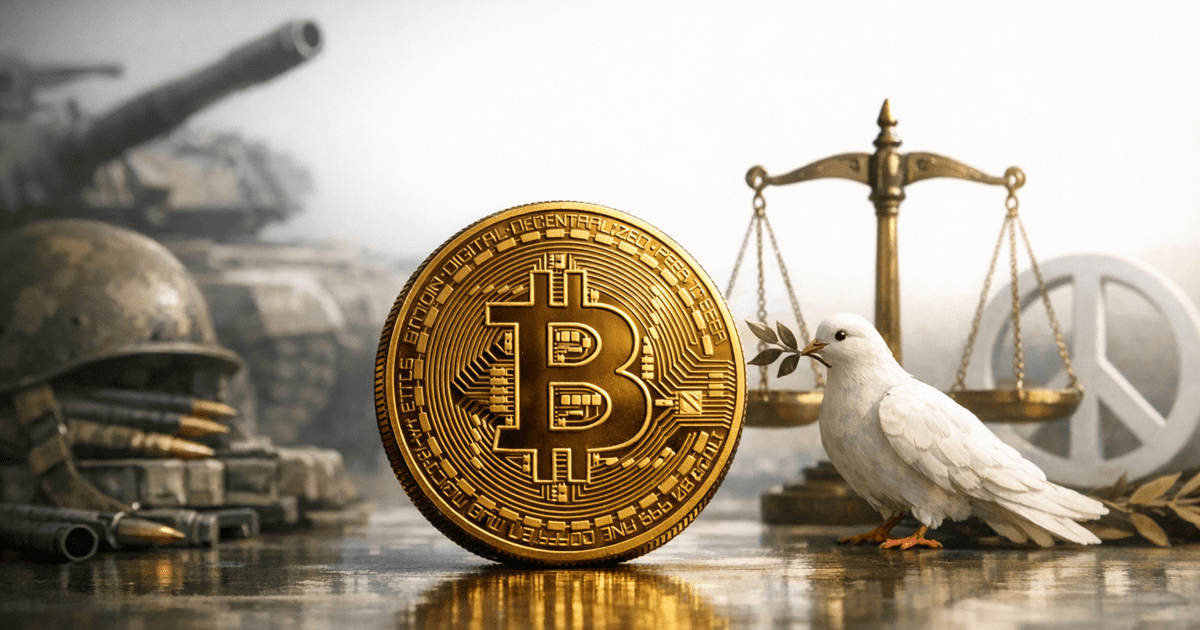
Bitcoin And The Hidden Cost Of War
Bitcoin is not a foreign policy doctrine. It does not negotiate treaties, command armies, or magically erase conflict from human history. War existed long before central banks, and it would still exist in a Bitcoin world. That is the first point to get clear.
But it is still reasonable, and important, to argue that Bitcoin is anti-war.

The reason is simple: war becomes easier when its cost can be hidden. And in the modern world, one of the most effective ways to hide that cost is through monetary expansion.
When a state can finance conflict not only through visible taxation or transparent borrowing, but also through inflation and money creation, it becomes easier to extend war beyond what the public would willingly support if they saw the full bill upfront. Soft money does not create the desire for war. It subsidizes the ability to wage it.
Bitcoin pushes in the opposite direction. It is hard money. It limits discretionary expansion. It makes dilution harder, audit easier, and financial reality more difficult to evade. That does not make Bitcoin pacifist in some naive sense. It makes Bitcoin hostile to one of the quietest mechanisms of state overreach.
War Is More Politically Possible When The Bill Is Obscured
In a sound-money framework, war is expensive in ways people can feel immediately. A state that wants to fight must tax more, borrow more openly, or demand direct sacrifice from its population. Those choices are politically painful because they force the public to confront the real tradeoff: if you want war, you must pay for it.
In a fiat system, that discipline weakens. Governments can still tax and borrow, but they also operate inside a monetary structure where central banking and monetary expansion can absorb part of the burden. The cost does not disappear. It gets redistributed across society in a more diffuse and less legible way.
That diffusion matters. When the public cannot clearly connect war policy to its financial cost, accountability declines. The state is no longer asking, in plain terms, “Will you fund this conflict?” It is quietly asking later through higher prices, weaker purchasing power, and a slower confiscation of savings.
Inflation is not just an economic event. In that context, it is a political technology.
Inflation Turns War Finance Into A Hidden Tax
People often hear that inflation is a tax, but they do not always follow the implication. If inflation can transfer purchasing power from the public to the issuer of money, then it becomes a tool for financing projects that might not survive direct democratic scrutiny.
War is exactly the kind of project that benefits from that opacity.
If citizens had to approve every major conflict through immediate, visible taxation, political leaders would face much more resistance. Families would ask harder questions. Businesses would calculate the burden more directly. Voters would demand clearer objectives and firmer limits. The distance between decision-makers and consequences would narrow.
Monetary expansion widens that distance. It lets policymakers spread the cost across millions of balance sheets, often with enough delay and confusion that the causal chain is hard to perceive. Prices rise. Asset markets distort. Savings erode. Yet the mechanism remains abstract enough that many people never connect the damage to the policy choices that produced it.
That is why hard money matters. It does not remove conflict from politics. It removes one of the easiest ways to disguise conflict’s cost.
Hard Money Restores Financial Honesty
The strongest moral argument for hard money is not that it makes every outcome good. It is that it makes tradeoffs harder to fake.
A society on harder money has fewer ways to pretend that enormous public commitments are free. It must recognize scarcity more honestly. It must admit that resources used in one direction are resources unavailable somewhere else. In that sense, hard money is not just an economic preference. It is a constraint on fantasy.
Bitcoin embodies that constraint in a uniquely modern form. Its supply is fixed by the protocol. Its issuance is transparent. Its rules are auditable. No emergency meeting can decide that more Bitcoin should exist to smooth over political costs. No committee can dilute every holder to fund one more round of state ambition.
That forces a harder conversation. If a government wants sustained war in a world where savings increasingly migrate into an asset it cannot print, it faces more visible limits. It must secure real resources through overt political means rather than partially masking the burden through currency debasement.
That is not just economically significant. It is morally significant.
Bitcoin Raises The Cost Of State Evasion
The phrase “anti-war” can sound exaggerated until you frame it correctly. Bitcoin is not anti-war because it makes conflict impossible. It is anti-war because it weakens a financing model that lowers the friction of war.
The state prefers flexibility. It prefers optionality. It prefers systems where costs can be shifted, delayed, socialized, or obscured. Fiat money gives governments more room to do exactly that. Bitcoin narrows that room.
If more individuals, institutions, and eventually nations hold part of their wealth in a non-sovereign hard asset, the effectiveness of monetary debasement as a policy escape hatch declines. The public gains a defensive tool. Savers gain an exit. Governments face a population that is harder to dilute silently.
That changes the political environment. It does not guarantee wise leaders. It does not guarantee peace. But it does remove some of the state’s ability to socialize extraordinary costs through an ever-expanding monetary base.
States do not like constraints. Bitcoin is a constraint.
Peace Is Stronger When Citizens Can Feel The Cost Of Power
There is a broader principle underneath all of this: power behaves differently when its cost is immediate and visible.
When rulers can externalize the cost of bad decisions, they make more of them. When institutions can hide the bill, they become more reckless. When the public cannot see what it is sacrificing, it has less leverage to say no.
That is not only true in war, but war is where the stakes are highest. A monetary system that makes state action look cheaper than it is becomes a dangerous companion to military power.
Bitcoin pushes toward the opposite social order. It rewards saving. It resists dilution. It encourages verification over trust. And it places a hard limit on how much monetary manipulation can be used to soften or conceal political choices.
A society grounded in harder money is not automatically peaceful. But it is better equipped to demand honesty from those who would spend lives and resources at scale.
Bitcoin Does Not End War, But It Removes One Subsidy
This is the key distinction. Bitcoin critics sometimes dismiss the anti-war argument by pointing out, correctly, that human conflict is older than fiat currency. That objection misses the point.
The claim is not that Bitcoin abolishes violence. The claim is that Bitcoin removes one important subsidy for large-scale, prolonged, politically insulated war finance.
That matters because subsidies shape behavior. Cheap credit changes behavior. Hidden leverage changes behavior. Off-balance-sheet promises change behavior. Monetary expansion changes behavior too. It lowers the apparent near-term price of state action while distributing the real cost more broadly and less transparently over time.
Bitcoin does not solve human nature. It does something more precise: it makes one form of state evasion harder.
For a civilization that has spent the last century normalizing inflation, debt monetization, and endless emergency powers, that is not a small thing. It is a structural challenge to how power finances itself.
Why This Frame Matters
If Bitcoin is only discussed as a speculative asset, its deepest social implications disappear. The anti-war frame restores part of what makes Bitcoin important beyond price.
Bitcoin is not merely an investment. It is a monetary rule set that limits arbitrary expansion. It is a savings technology that protects individuals from silent dilution. And it is a political constraint that makes it more difficult for states to disguise the cost of their ambitions.
Hard money cannot create virtue by itself. But it can make vice more expensive.
That is enough reason to take the peace implication seriously.
Bitcoin Is Not Pacifism. It Is Monetary Accountability
The strongest version of this argument is also the most sober one. Bitcoin does not promise a utopia. It does not guarantee peace treaties, moral leaders, or perfect institutions. What it does offer is a system in which the public has a better chance of seeing the cost of state action before that cost is buried in the currency.
That is why Bitcoin is anti-war.
Not because it eliminates conflict.
Because it makes it harder to hide the price.
Discussion
Join the Conversation