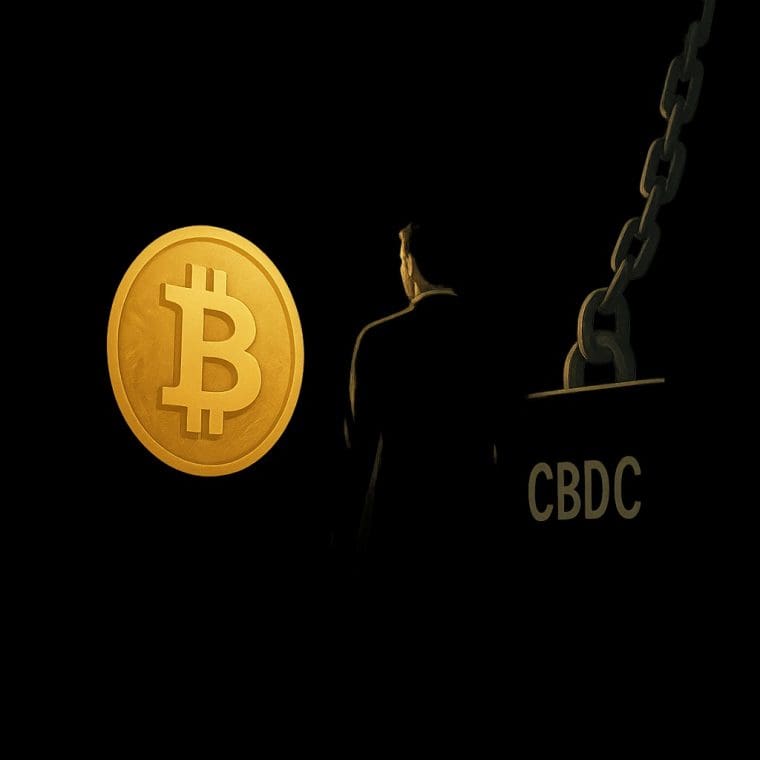
Analyze recent regulatory statements on Central Bank Digital Currency (CBDC) programmability and offline-capability trade-offs, contrasting these design choices with Bitcoin's non-programmable, censorship-resistant settlement model. Frame the operational implications for individual autonomy and sound money.
Transcript
Mike: You’re listening to BitTalk, a podcast about Bitcoin, money, freedom, and the ideas that matter.
Mike: (Music fades) I’m Mike, here for the signal, not the spin. If you’ve been following the news out of central banks and BRICS meetings, you’ve seen a surge in talk about digital currencies. But the real story isn’t just digitization—it’s about programmability. The ability to code money with rules that govern how, when, and where you can spend it. Today, we’re putting that design philosophy directly against Bitcoin’s model of final, censorship-resistant settlement.
Lauren: Hey everyone, I’m Lauren. Let’s jump in. The fresh angle here is urgent: from China to India, we’re seeing real policy moves that highlight this trade-off between state-controlled efficiency and individual financial autonomy. It’s a technical choice with profound human consequences.
Mike: Exactly. So today, we’re going to demystify CBDC programmability, contrast it with Bitcoin’s fixed rules, and unpack what this means for operational sovereignty and the concept of sound money. Lauren, let’s start with the headlines. What recent developments are bringing this clash into sharper focus?
Sponsor (intro):
If you’re looking for a simple, Bitcoin-first way to buy, save, and learn, the platform is built for exactly that. Start stacking with Swan Bitcoin. Visit SwanBitcoin.com.
Lauren: All right. The core promise—or pitch—of CBDCs from a central bank’s perspective is enhanced monetary policy and payment efficiency. But the mechanism is programmability. This means the digital currency unit itself can have conditions attached by its issuer. Think expiration dates to force spending, geographic locks, or rules like “this can only be used for groceries.”
Mike: So it’s less like digital cash and more like a sophisticated, traceable voucher system managed by the state.
Lauren: Precisely. And we’re seeing this move from theory to practice. China is upgrading its digital yuan for cross-border use with mandatory real-name verification, stripping away earlier limited anonymity. India’s central bank is actively pushing its digital rupee and exploring BRICS-wide CBDC links. The thread here is visibility and control.
Mike: Give us a concrete, operator-style example of how this programmability might function in the real world.
Lauren: Sure. Imagine a stimulus payment coded to expire in 90 days to “boost the economy,” or funds for a small business loan that can only be spent at approved vendors. The recent Human Rights Foundation report highlighted a powerful anecdote: during the Ukraine conflict, Russia faced massive cash withdrawals—over 1.6 trillion rubles—as people sought to escape potential digital account freezes. A fully operational CBDC system could have made that flight nearly impossible.
Mike: That’s a stark illustration. So the trade-off they’re offering is: accept this programmability for supposed efficiency and policy precision, but in doing so, you grant a central authority an unprecedented tool for surveillance and behavioral nudging.
Lauren: It reminds me of a gift card, but one where the store manager can not only see everything you buy with it, but can also deactivate it if you try to use it in the wrong aisle.
Mike: And change the remaining balance overnight. A truly terrible gift card.
Lauren: Exactly. So let’s pivot to Bitcoin. Its design seems to be an answer to this exact problem. How does its architecture differ at a fundamental level?
Mike: The contrast is in the foundational layer. Bitcoin is non-programmable in the CBDC sense. Its core protocol rules are fixed and immutable: a 21 million supply cap, a 10-minute block target, a proof-of-work consensus mechanism. No single party can change these. Transactions are pseudonymous broadcasts to a peer-to-peer network. Once settled—typically after 6 confirmations—they are effectively irreversible and censorship-resistant.
Lauren: Break down “censorship-resistant” for a beginner. Why is that a feature, not a bug?
Mike: It means no intermediary—not a bank, not a government—can prevent a valid transaction from being included in the blockchain, provided you pay the network fee. They can’t freeze your bitcoin because you’re traveling, or because they disagree with who you’re paying. Your keys, your bitcoin. This is permissionless-ness in action.
Lauren: And this ties directly to the concept of final settlement. On the Bitcoin base layer, there is no “rollback” function.
Mike: Correct. It’s a system designed for finality. This is radically different from the traditional and CBDC model, which is based on ledger entries that can be adjusted, reversed, or blocked by the ledger keeper. Bitcoin shifts the power from the validator to the holder of the private keys.
Lauren: So if CBDC is like having a bank manager with a master override switch for your account, Bitcoin is like having a physical safe with a unique key. Only you have the key.
Mike: That’s a great simple analogy. And running a Bitcoin node is like having your own independent auditor verifying that the rules of the safe—its size, its security mechanism—haven’t been tampered with by anyone.
Lauren: This isn’t just theoretical. What are the concrete, operational implications for someone trying to preserve their financial autonomy in a world moving toward programmable CBDCs?
Mike: The first-order implication is the need for self-custody. We’ve covered hardware wallets and multisig before, but this context gives it new urgency. Holding your own keys on a device you control is the primary hedge against the counterparty risk inherent in CBDCs and traditional finance.
Lauren: And offline capability is often touted as a privacy feature for some CBDCs, like the digital euro.
Mike: Right, but there’s a critical distinction. With CBDCs, offline functionality is a granted feature, one that can be revoked or limited by policy. With Bitcoin, the ability to create and broadcast transactions offline—using tools like satellite receivers, mesh networks, or even USB drives—is an emergent property of its peer-to-peer, protocol-level design. The HRF report we mentioned details tools like Nostr-based VPNs being used to maintain Bitcoin access in censored environments. The resilience is baked in, not optionally provided.
Lauren: So the operational takeaway is to prioritize sovereignty tools: self-custody setups, understanding how to run a node for verification, and being aware of communication tools that keep you connected to the Bitcoin network independently.
Mike: Exactly. It’s about reducing your points of failure. A CBDC, by design, has a central point of failure: the issuing authority. Bitcoin’s security and function are distributed across a global, decentralized network.
Sponsor (mid-roll):
If you’re looking for a serious, Bitcoin-only approach to building your savings, our sponsor Swan Bitcoin is built for that. They cut through the crypto noise with recurring buys, Bitcoin IRAs, and self-custody options like Swan Vault. It’s all designed to help you build long-term conviction. Learn more at SwanBitcoin.com.
Mike: And we’re back. Let’s tie this back to first principles: sound money. How does CBDC programmability interact with, or potentially undermine, the properties of sound money?
Lauren: Sound money requires predictability and scarcity immune to arbitrary manipulation. Bitcoin’s algorithmic scarcity is its cornerstone. CBDCs, however, are inherently tied to central bank balance sheets. Programmability becomes a new, powerful tool for monetary manipulation that goes beyond just printing more. It allows for targeted inflation or demurrage—negative interest rates coded directly into the currency unit itself.
Mike: So it’s not just creating more money, it’s about controlling the velocity and direction of money with surgical precision.
Lauren: Yes. Imagine a central bank, worried about deflation, programming a portion of everyone’s CBDC holdings to lose 2% of its value per month unless spent. That’s a forced velocity tool. Bitcoin cannot do that. Its monetary policy is transparent, predictable, and executed by code, not committee. This is why “stacking sats” in a self-custodied wallet is a direct vote for a predictable monetary system over a programmable one.
Mike: It strikes me that this brings our earlier episode on Bitcoin’s fixed supply full circle. The threat isn’t just inflation by quantity, but inflation of control—the ability to dictate the terms of use.
Lauren: Absolutely. And that control fundamentally alters the relationship between the individual and the state. Money becomes a tool for behavior modification, not just a neutral medium of exchange and store of value.
Mike: To synthesize: we’re seeing a fork in the road for the future of money. Down one path, state-issued digital currencies offer efficiency gains built on programmability and pervasive oversight. Down the other, Bitcoin offers a credibly neutral, censorship-resistant settlement network with a fixed, sound monetary policy.
Lauren: The choice ultimately comes down to what you value: the convenience of a managed system or the sovereignty of an open one. For operators, the task is clear: understand the tools of self-custody, run a node, and engage with the Bitcoin network directly. That’s how you ground yourself in the principles of sound money.
Mike: Well said. Lauren, thanks as always for sharpening the analysis.
Lauren: Anytime, Mike.
Mike: Thanks for spending time with us on BitTalk. Until next time, keep learning, keep questioning, and keep stacking knowledge. (Music fades in).
Discussion
Join the Conversation